The Foundation of Independence: The Practical Life Curriculum
How purposeful everyday activities, real-world tools, and intentional movement cultivate self-discipline, concentration, and profound autonomy in the young child.
Author: Liam Murray · Montessori Mentor
Focus: Children's House (Ages 3–6)
Reading Time: ~10 min
Observing the needs of the child
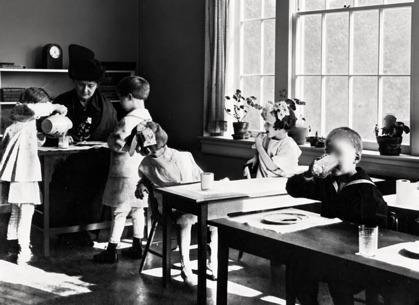
Maria Montessori’s development of the Practical Life curriculum was rooted in her observations of children and her belief that learning should be grounded in real-world experiences. Her work began in the early 20th century when she opened the first Casa dei Bambini (Children's House) in San Lorenzo -a working-class neighborhood in Rome- in 1907, a setting which allowed her to study how young children interacted with their environment. As she observed the children, she noticed that they were naturally drawn to activities that mirrored adult tasks such as sweeping, pouring water, or buttoning clothes, and that these actions not only engaged the children but also supported their cognitive and physical development.
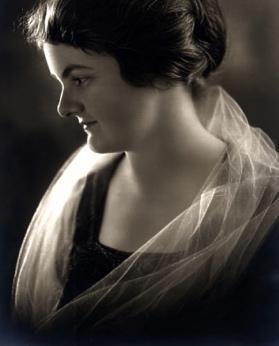
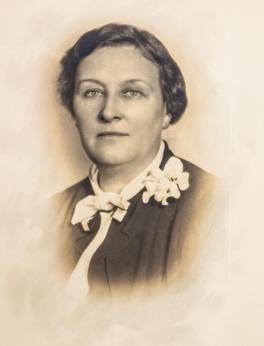
Dr. Maria Montessori observing children engaged in authentic practical life activities in the early Casa dei Bambini.
"Experience shows that it is useless and harmful to give the children Sensorial and Cultural apparatus before they are ready to benefit from it. Before introducing this kind of material, one must wait until the children have acquired the power to concentrate on something, and usually . . . this occurs with the exercises of Practical Life. When the child begins to show interest in one of these, the teacher must not interrupt, because this interest corresponds with natural laws and opens up a whole cycle of new activities. . . . The teacher, now, must be most careful. Not to interfere means not to interfere in any way. This is the moment at which the teacher most often goes wrong. The child, who up to that moment has been very difficult, finally concentrates on a piece of work."
- Maria Montessori, The Absorbent Mind, pp. 277-81. (1949)
Rather than dismissing such behaviors as mere imitation, Montessori recognized them as essential steps in a child’s growth toward independence and self-regulation, and she theorised that by engaging in meaningful, purposeful work, children could develop internal order, coordination and confidence. Montessori emphasised that these exercises were not merely preparatory for academic learning but were fundamental to a child’s overall growth, fostering independence and self-discipline. From these observations, she developed a series of materials and exercises aimed at refining motor skills while developing coordination of movement, her approach emphasising repetition, sequential learning, and the use of real-life tools adapted for small hands, ensuring that each activity provided both challenge and fulfillment.
‘If teaching is to be effective with young children, it must assist them to advance on the way to independence. It must initiate them into those kinds of activities, which they can perform themselves. We must help them to learn how to walk without assistance, to run, to go up and down the stairs, to pick up fallen objects, to dress and undress, to wash themselves, to express their needs, and to attempt to satisfy their desires through their own efforts. All this is part of an education for independence."
- Maria Montessori, ‘The Discovery of the Child’, p. 56. (1967)
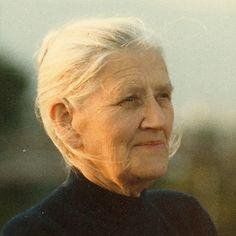
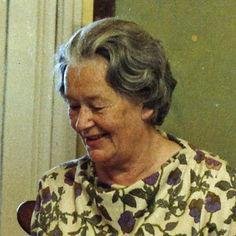
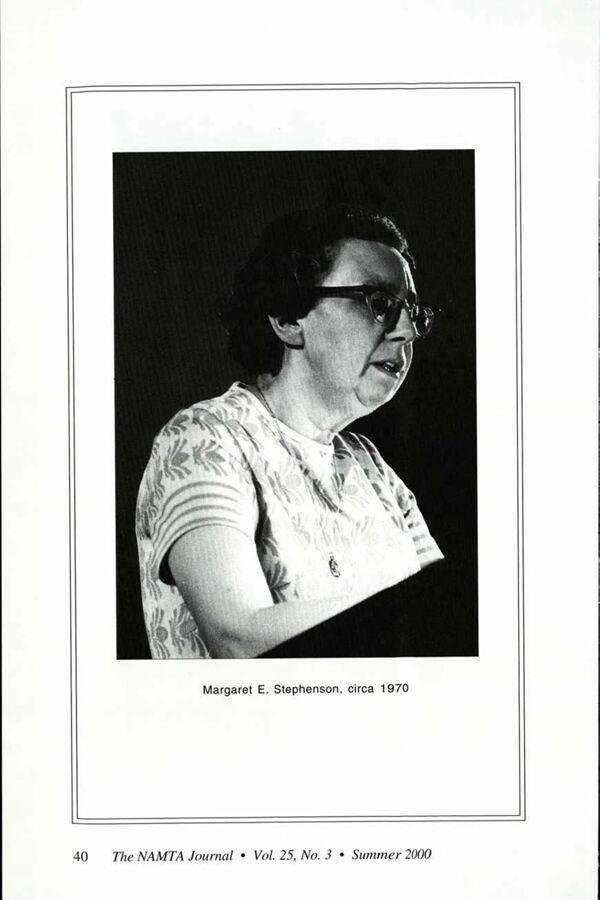
As she expanded her work beyond Italy, Montessori traveled extensively, observing children across different cultures and adapting her methods to suit diverse environments and the curriculum underwent continuous refinement as her educational philosophy matured. She collaborated with educators and psychologists to further develop the materials, working closely with colleagues such as Helen Parkhurst and Adelia Pyle -who helped introduce Montessori education in the United States- and later with figures like Margaret Homfray, Phoebe Child and Margaret Stephenson, who contributed to refining teacher training programs.
These collaborations ensured that the Practical Life curriculum remained dynamic and responsive to new insights in child development, but certain characteristics and principles remained foundational.
Left to right: Helen Parkhurst, Adelia Pyle, Margaret Homfray, Phoebe Child and Margaret Stephenson.
Characteristics of the Practical Life Materials
Real and functional
The materials are not toys but serve a purpose and are real working tools made of wood, metal, or glass, natural to the child’s environment and culturally appropriate.
Child-sized
All of the materials are objects which the child can manipulate and control, enabling independent use.
Whole and complete
All of the parts must be present and functional.
Aesthetically pleasing
In order to capture the interest of the child.
Varied
There must be a wide range of exercises available, providing the child with a multiplicity of choice.
Accessible
When the child needs an exercise, they must be able to work upon it, so the materials are arranged on child-sized shelves.
Principles of the Practical Life Curriculum
Isolation of Difficulty
Each activity focuses on one primary skill e.g., pouring focuses only on the pouring motion, and fastening focuses only on that specific type of fastener, etc.
Control of Error
Materials are designed so the child can perceive their own mistakes and correct them without adult supervision or intervention e.g. a spill reveals incorrect pouring, or an unevenly buttoned vest is visually obvious.
Logical Sequence
The materials are laid out in a logical progression from simple to complex, building skills incrementally, and the exercises are presented in steps, with a defined beginning, middle, and end. This is known as the Cycle of Activity where each exercise utilises the same three-stage cycle:
Allow for Repetition
The materials invite and encourage repetition, which is a key to both mastery and satisfaction.
The Cycle of Activity: Three-Stage Cycle
Each exercise utilises the same three-stage cycle:
Step 01
Take the material to table
The child selects the exercise from the shelf and carries it safely to their workspace.
Step 02
Engage with it
The child works through the exercise, repeating the activity with deep concentration.
Step 03
Return it to the shelf
The child restores the activity to its complete state and returns it to its proper place.
Buying Materials
Personal Guide Reflection
Because the environment must reflect the local culture, the materials will vary from country to country, which makes Practical Life the most challenging area for new teachers to set up, because they don’t have a list of prescribed materials to follow. For the same reason, it’s my favourite area to prepare because it’s challenging but also interesting to go shopping and try and figure out how something might be adapted and made suitable for the needs of the children.
‘There is no limit to the equipment of the “Children’s Houses” because the children themselves do everything. They sweep the rooms, dust and wash the furniture, polish the brasses, lay and clear away the table, wash up, sweep and roll up the rugs, wash a few little clothes, and cook eggs.’
- Maria Montessori, Dr. Montessori’s Own Handbook, pg. 44. (1914)
Aims of the Practical Life Curriculum
The Practical Life curriculum is designed to support a child’s holistic development by fostering essential life skills through purposeful, hands-on activities that have both direct and indirect aims. The direct aim of each exercise is to complete that particular exercise; for example, the direct aim when pouring beans is to pour the beans without spilling them, and the direct aim when using the Buckle Frame is to open and close each of the buckles. However, each task also has a variety of indirect aims which extend beyond the completion of a task, and include development of the following qualities:
Independence
The children engage in meaningful tasks that mirror real-life experiences, and by mastering activities such as pouring water, buttoning clothes, or setting a table, they gain confidence in their abilities and develop their independence. This emphasis on autonomy aligns with Montessori’s belief that children learn best when they are actively involved in their environment rather than passively receiving instruction.
“The children of three years of age in the "Children's Houses" learn and carry out such work as sweeping, dusting, making things tidy, setting the table for meals, waiting at table, washing the dishes, etc ., and at the same time they learn to attend to their own personal needs, to wash themselves, to take showers, to comb their hair, to take a bath, to dress and undress themselves, to hang up their clothes in the wardrobe, or to put them in drawers, to polish their shoes. These exercises are part of the method of education, and do not depend on the social position of the pupils; even in the "Children's Houses" attended by rich children who are given every kind of assistance at home, and who are accustomed to being surrounded by a crowd of servants, take part in the exercises of practical life. This has a truly educational, not utilitarian purpose. The reaction of the children may be described as a "burst of independence" of all unnecessary assistance that suppresses their activity and prevents them from demonstrating their own capacities. It is just – these "independent" children of ours who learn to write at the age of four and a half years, who learn to read spontaneously, and who amaze everyone by their progress in arithmetic.”
Maria Montessori, From Childhood to Adolescence, p. 66. (1948)
Coordination of Movement
Young children naturally seek opportunities to control their bodies, and the structured sequence of movements and repetitive, intentional actions required in activities such as carrying a tray without spilling, sweeping a floor or walking on the line help to refine both gross and fine motor control and contribute to the development of muscle memory, balance, and precision.
‘The children love to do these things [practical life activities] for themselves and they learn to be careful and precise in their movements. This is both education of movement, because there is a refinement of muscular co-ordination when the work is carefully done, and education through movement, because these activities involve judgement and will, self-discipline, and an appreciation of orderliness’.
Maria Montessori, ‘Maria Montessori Speaks to Parents’, p. 49. (2017)
Concentration
Each exercise is designed with a clear sequence of steps, and the use of real tools and tangible outcomes creates an intrinsic motivation to complete tasks successfully, encouraging children to engage deeply in their work. Through repetition, the exercises reinforce perseverance and attention to detail, helping the child to develop longer attention spans.
A Sense of Order
Each activity has a specific place on the shelf and is presented in a sequential manner with a clear beginning, middle and end, and this external order helps the child to develop logical thinking, internal discipline and emotional regulation.
Social Development
Children learn social graces, empathy, patience, and responsibility through daily living and collaborative tasks. Activities like setting a table for peers, offering food, practicing Grace and Courtesy and learning to wait one's turn foster awareness of others, cooperation, and respect for the community.
Groups of Practical Life Exercises
Elsewhere I have written about the different ways the exercises of Practical Life can be grouped, and the following grouping has a clarity and logic that I like:
01
Preliminary Exercises
02
Elementary Movements
03
Care of the Environment
04
Care of the Person
05
Grace and Courtesy
06
Control of Movement
In-Depth Exploration: Groups 1 & 2
Group 1
Preliminary Exercises
Purpose
Preliminary Exercises are the constituent parts of every exercise, with these movements later used as the component parts of more elaborate, complex presentations, helping to build and refine gross and fine motor skills, establishing ground rules for using the environment, and designed to familiarize the child with classroom procedures. As such, these will be some of the first exercises the child will receive after they join a Montessori class.
Sample Preliminary Exercises
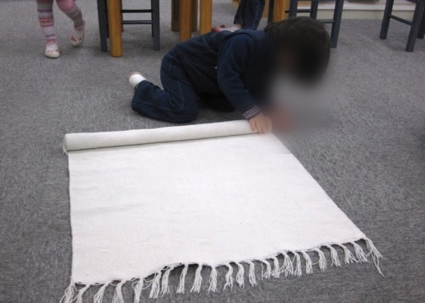
Rolling and unrolling a mat
Opening and closing blinds, curtains, etc.
Carrying
Folding: cloths, napkins, tea towels, etc.
Squeezing a sponge
Turning the pages of a book
How to use: knife, fork, pegs, etc
Opening and closing: drawers, cabinets, doors, etc
How to fill and empty a: schoolbag, work-folder, work-drawer, etc.
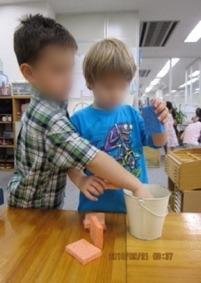
Carrying and putting down: scissors, chair, book, tray, jug, etc
Materials
Brushes (standing and hand), dustpan
Mats - large and small (for floor and table)
Apron
Pegs and clothesline
Clothes, napkins, tea towels, etc.
Sponges
A selection of books of different sizes
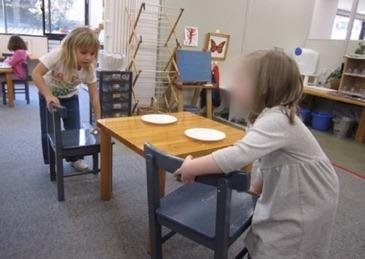
Carrying a chair carefully with two handsCarrying and balancing classroom equipment
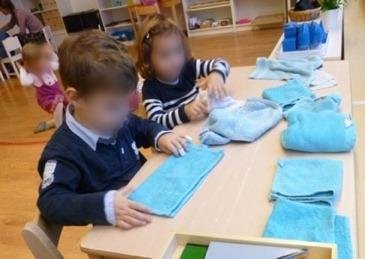
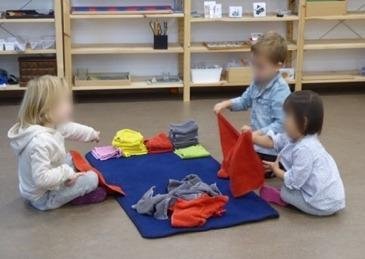
Standing brushes, hand brushes and folding clothsSponges, clothes pegs, and washing line setup
Group 2
Elementary Movements
Purpose
Transferring exercises, such as using tongs to move cotton balls from one bowl to another or spooning beans between containers, develop hand-eye coordination and dexterity. Pouring beans, grains, liquids etc. using jugs of varying sizes allow children to practice controlled movements and require precise hand-eye coordination and concentration, improving balance and precision. More elaborate exercises include food preparation.
Transferring with tongs and fine grasp toolsPouring grains and liquids with precision
Sample Elementary Movements
Transferring using jugs, cups, bowls, spoons, tongs, tweezers, chopsticks, basters, eyedroppers, etc.
Opening and closing: safety pins, boxes, bottles, etc
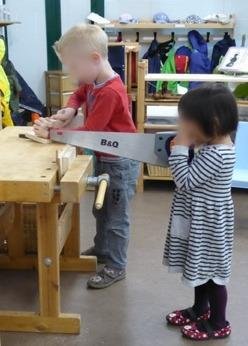
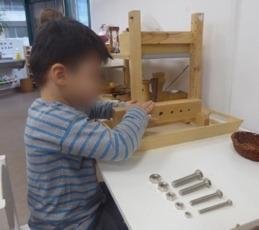
Use of tools: locks and keys, nuts and bolts, hammer, screwdriver, stapler, etc.
Sorting by: colour, shape, size, etc.
Food preparation & Sewing
Food preparation: peeling, slicing, cutting, rolling, scooping, sifting, squeezing, grinding, etc. using bananas, pickles, oranges, cucumbers, apples, carrots
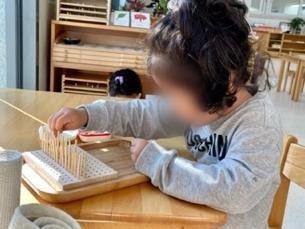
Food prep: slicing bananas and peeling fruitOpening and closing boxes and tool usageSystematic sorting by color and shapeLacing cards and initial needle handlingSewing buttons and sewing shapes
“I realised that the necessary movement of the hand for sewing had been prepared without sewing, and that before teaching it is first necessary to find the way to teach. This is particularly true when it is a question of gaining facility in movements. These could be carried out almost automatically through repeated exercises even apart from the work for which they were directly intended. In this way one could set himself to a task and be already capable of carrying it out without ever having directly put his hand to it, and he could complete it almost perfectly at the first attempt.”
Maria Montessori. The Discovery of the Child, p. 196. (1948)
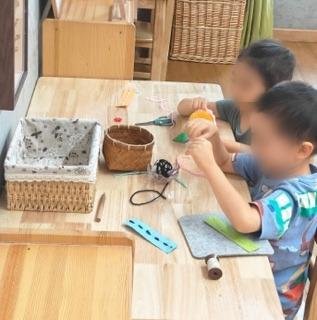
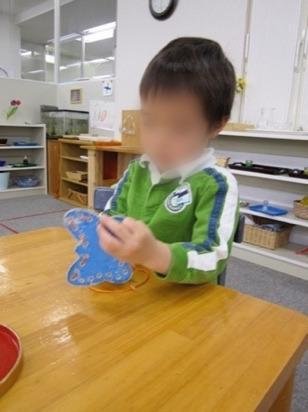
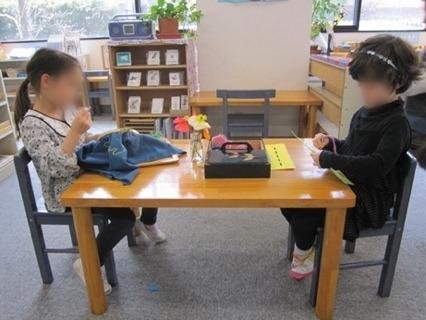
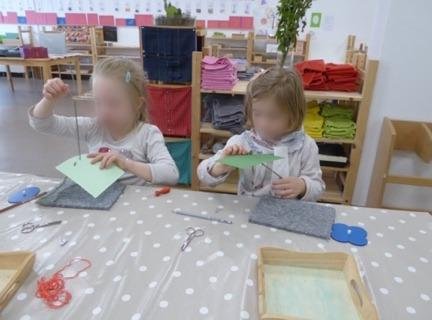
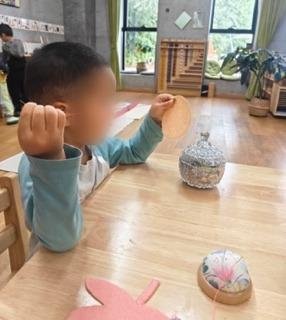
Threading and sewing
These photos show the sequence of presentations, from threading large beads to (roughly two years later) embroidery.
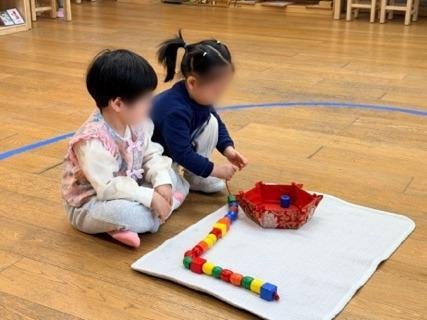
1. Threading large wooden beads2. Threading smaller beads & cord3. Lacing cards with blunt needle4. Threading a sewing needle5. Sewing 2-hole and 4-hole buttons6. Sewing shapes and running stitch7. Sewing fabric seams8. Simple frame weaving9. Embroidery and cross-stitch (~2 years later)
Related Resources & Curriculum Guides
Deepen your exploration of authentic Montessori practice across related areas: